
Tenth Sunday after Pentecost
- Aug 2, 2015
- 6 min read
This evening, I’m flying to Chicago for a couple days
to be with my spouse Michael and his family.
A few weeks ago, his Mom was diagnosed with breast cancer.
And on Tuesday, she’ll undergo a double mastectomy.
We found out about this news when Michael and I were with my Mom last month
for her surgery and recuperation at Johns Hopkins Medical Center in Baltimore.
As Queen Elizabeth II once said about one of her more trying years,
for our mothers, it seems 2015 has turned out to be an annus horribilus.
Obviously Michael’s reaction to his Mom’s cancer,
and my reaction for that matter,
was shock and disbelief.
There was also anxiety as we faced many difficult questions:
How advanced was her cancer?
What kind of treatment would she need?
And even, what would we do if she died?
There was also anger.
Even my being a priest,
and Michael being a professor of theology
couldn’t keep us from being angry at God.
Why did his Mom have to get cancer?
Of all people.
She’s a nurse, for crying out loud,
and one of the kindest Midwesterners you’ll ever meet.
And why did she have to get cancer now?
As if tending to one sick mom who lives three thousand miles away wasn’t enough.
Well, I wanted to tell you a story about something unexpected that happened in the midst of all this.
On the Sunday that my Mom was still recuperating in the hospital in Baltimore,
Michael and I decided to take a Sabbath from caregiving
and go to Washington D.C. for the day, an hour away.
First, we visited the National Gallery on the mall,
and then, we went to the National Botanic Gardens
where there is huge conservatory filled with tropical plants.
I was way more excited about seeing the plants than Michael,
so he decided to sit on a bench inside the main glasshouse while I explored.
I think having some quiet time to just sit and be
finally brought Michael’s emotions about his Mom to the surface.
I think he’d felt like he needed to be stoic
so he could be strong for my Mom.
And up until now, he hadn’t shed a tear.
But all of a sudden, right then and there on the bench in conservatory,
the tears for his Mom poured out.
People saw him crying, but everyone kept on walking and didn’t stop.
Except for one woman.
A middle-aged black woman wearing a baseball cap.
When she saw Michael crying, she walked right over to him,
and put her hands on his shoulders.
“You look like you need a hug,” she said.
Before he could say anything, she grabbed him
and wrapped her arms around him, and pulled him close.
“Now tell me,” she said. “What’s wrong?”
So he told her about his Mom having breast cancer.
And the woman said, “So that’s why I had to come over to you.
I’ve got breast cancer too,” she said.
“In fact, just finished my chemo!”
“Look,” she said, taking off her cap and showing him her head,
bald, and covered with a scarf.
“And look here,” she said, pulling down her shirt enough for us to see the wound left by her chemotherapy port.
Around this time, I arrived on the scene to find Michael talking with this strange woman
who was showing him half of her chest.
We introduced ourselves, and then she introduced herself.
“Name’s Barbara Tyler,” she said. “But folks call me Tyler.”
Well, Barbara Tyler went on to tell us her story:
when she’d been diagnosed with cancer;
how her initial prognosis hadn’t been great;
how she’d nearly died in the hospital,
but somehow lived;
how cancer had changed her.
And not just taken life from her,
but given her new life.
“Today is all we have, honey,” she said to Michael.
“I was expecting to be dead, but I’m here today with my family,”
she said, pointing to her daughter a few feet away.
From the embarrassed look on her daughter’s face,
I could tell this probably wasn’t the first time
Barbara Tyler had stopped to hug a complete stranger.
“I never thought I’d survive,” she said.
“But I did, and so will your Mom. Everything’s going to be fine.
God never abandons us. And God never gives us more than we can handle.”
Every time I’d heard someone say this before,
that God never gives us more than we can handle,
I’d wanted to smack them.
But somehow, coming out of this woman’s mouth,
in this moment,
it seemed like it could almost be true.
“Now listen,” she said to Michael.
“You gotta be strong. You gotta be a strong son to your Mom.
There’s gonna be pain. There’ll be some tears too.
But everything is going to be alright, honey.
You hear me? It is.”
She grabbed Michael again, and enveloped him in her arms once more.
And then she grabbed me too.
“Now you all take care.”
And just like that, she was gone.
For a while, the two of us just sat on bench,
dumbfounded at what had just happened.
yet certain that Barbara Tyler’s coming was no accident.
Call her a guardian angel.
Call her whatever you want.
All we knew—all Michael knew—
was that she had shown up in the moment he most needed her.
And she had said to him the words he most needed to hear in this time of trial,
words that have sustained him,
and me,
and will, I have no doubt,
continue to sustain us in the weeks and months ahead.
This story was already inhabiting my heart this week
when I read this morning’s reading from Exodus,
this story about how God sustained the Israelites in the wilderness.
You might remember, the Israelites had been slaves in Egypt for generations.
Today’s story picks up just after they’ve escaped the Egyptians.
And just after they’ve gotten their first taste of freedom,
they are plunged into the wilderness,
into yet another time of trial.
They are starving and vulnerable
and, understandably, angry at Moses and Aaron for leading them into this mess.
Being slaves in Egypt was better than this, they say!
At least then, we knew where our food was coming from!
Well, just as their cries reach a feverish pitch,
the unexpected happens.
God speaks to Moses,
and says that he is going to rain down bread from heaven for the people.
God tells Moses that he has heard the cries of the people,
and that he’s going to send quails to come in the evening,
and in the morning, after the dew lifts,
a fine, flaky substance called manna,
the translation of which, from Hebrew, means literally “what is it?”
“So God commanded the clouds above
and opened the doors of heaven,” the writer of today’s Psalm says.
“God rained down manna upon them to eat
and gave them grain from heaven.
So mortals ate the bread of angels;
God provided for them food enough…
So they ate and were well filled,
for God gave them what they craved.”
Just as God had been with the Israelites in Egypt,
and just as God had gone before them as they crossed the Red Sea,
God shows up in this moment of need, vulnerability, and uncertainty.
God provides for them.
God sustains them, albeit in an unexpected way.
As if God miraculously raining down bread from heaven
weren’t the most amazing story about God showing up
and providing for God’s people,
today’s Gospel is an even more amazing story
A story about how God again heard people’s hungry cries.
And just like in the wilderness, God decided to respond
by doing something unexpected:
Not just to hear their cries,
as if from far away.
and send bread from heaven for them to eat.
No, this time, something else.
This time, in Jesus, God chose to become bread for the people.
Not only to give them food, but to be their food.
The bread that that gives life to the world.
In the Gospel story, Jesus is trying to explain this to the people.
I’m not sure they understand what he’s talking about.
How could they?
But what they do know is that they’re hungry,
and this man says he can offer them food.
And so they say, “Give us this bread, always.”
And Jesus says, “I am the bread of life.
“Whoever comes to me will never be hungry,
and whoever believes in me will never be thirsty.”
I have to be honest,
I still struggle with the idea that
“God never gives us more than we can handle.”
I struggle with the idea that God would will anyone to suffer,
even for the sake of trying and testing us.
But I have experienced that God hears our cries.
And I have experienced that in Jesus,
God makes a choice to be with us,
sometimes in unexpected ways
and unexpected people.
As unexpected as manna in the wilderness
or Barbara Tyler.
And I have experienced that God chooses to be with us here.
In this place.
In this community.
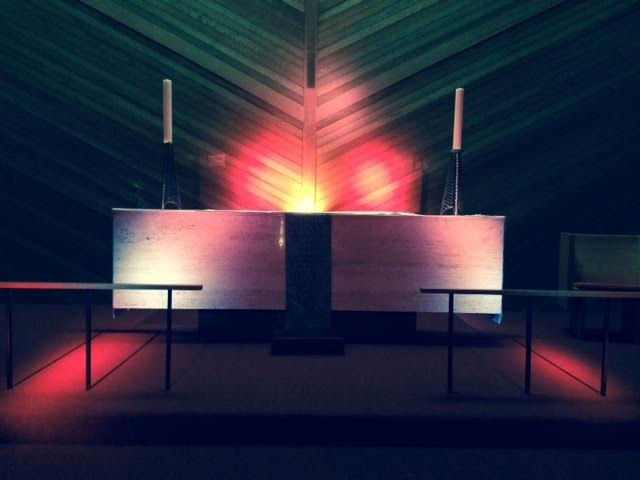
At this altar.
Where by the power of the Holy Spirit,
Jesus dwells with us in bread and wine.
And we get a taste of his promise
that with him as our food,
we will never be hungry.
Amen.


Comments