
A different kind of king
- Nov 22, 2015
- 6 min read
John 18: 33-37
Today’s celebration,
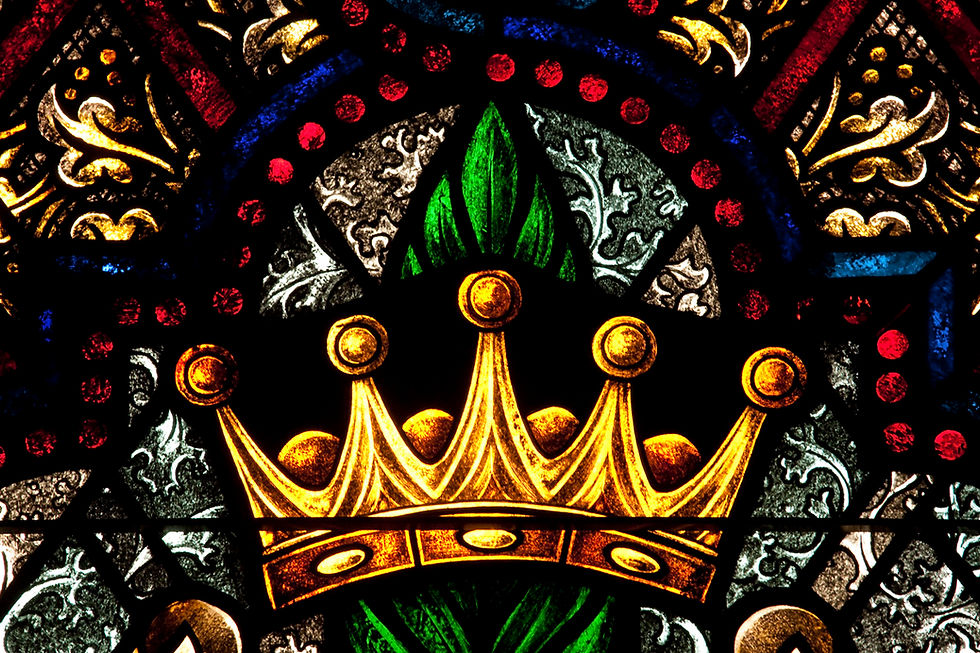
the feast of Christ the King or Reign of Christ Sunday
is the last Sunday of the Church’s year.
The liturgical year will begin anew next Sunday,
the first Sunday in Advent.
The idea of taking a Sunday to celebrate Christ’s reign
is actually a relatively new addition to the Church’s calendar.
The feast of Christ the King was first proclaimed
by Pope Pius XI in 1925, partly in response to the rise of extremism in Europe.
As totalitarian governments began to proliferate,
Pius sought to remind Christians that it was Jesus Christ who ultimately reigned as king.
And it was to him that Christians owed they loyalty,
not to any dictator or regime.
Today’s feast was meant to remind Christians,
in a time of great upheaval, that Jesus didn’t look like other rulers,
and he didn’t rule like other rulers.
And so today,
in our readings and in the hymns we sing,
we too proclaim the reign of Christ in our own midst.
In Daniel, God, the ancient one, appears on a fiery throne
served by a thousand thousands and attended by ten thousand thousands.
In Psalm 93, the psalmist extols God as a king,
one who is robed in majesty and girded in strength,
whose throne is everlasting,
and who is more majestic that the mighty waters and the waves of the sea.
And in our reading from Revelation,
John of Patmos tells the churches to watch for the one
who is coming from the clouds,
the Alpha and Omega,
the Lord God who is, and who was and who is to come, the Almighty.
Of course, as Americans, we might be just a little uneasy
with whole idea of having a king, even if it is Jesus.
As some of you might know, I grew up in Yorktown, Virginia,
the site of the British surrender during the American Revolution.
My mom actually worked for the national park there,
and we lived in a house that was quite literally on the edge of the battlefields.
So my childhood was steeped in all the stories about
how we threw off the yoke of tyranny imposed on us by a king,
and claimed liberty for ourselves.
As Americans, at least in theory,
we place our trust in a political system of checks and balances.
We have always been suspicious of people who are born into power,
and of too much power concentrated in the hands of a single person.
And so, the founders tried to ensure that the business of governing
would be shared by many rather than just a few.
And yet, for all of our suspicion about kingship and power in the hands of a few,
we Americans certainly do know a thing or two about power.
And it is power that I think is really at the heart of today’s celebration.
As Americans,
we live in the most powerful nation in the history of humankind.
Our nation has the most powerful military in the world.
Our economy is the most powerful economy.
Our homes and offices burn nearly a third of the earth’s energy resources.
And as a nation, we spend trillions of dollars each year holding onto our power,
protecting it, making sure that it doesn’t fall into the “wrong hands.”
Holding onto power is an expensive and exhausting task.
But, in spite of the nearly overwhelming power held by our country as a whole,
not everyone has an equal share in this power.
Some in this country, by virtue of where they were born,
or the color of their skin,
or their gender,
or their education,
enjoy a lot more power and privilege than others.
This includes us, right here in this congregation.
Not all of us share the same amount of power.
Some of us enjoy a great deal of power.
On the other hand, some of us have known was it is like to be disempowered.
To have power and our rights taken away.
The distribution of power in this world is and always has been unequal.
This should make us uncomfortable.
It should make us long a world that is different.
Which I think is where Jesus and our Gospel story come back into the picture.
Many of the people of Jesus’ day longed for a world that was different, too.
Many of the people who followed Jesus were themselves disempowered
or dissatisfied with the status quo.
They had been living under Roman occupation for nearly a hundred years,
and Roman rule could be oppressive and cruel.
In the midst of this regime,
Jews around the time of Jesus were eagerly awaiting a messiah.
someone who would come and liberate them.
Messiah literally means, “anointed one”—
one who is anointed just as kings are anointed with oil.
Most Jews were expecting a messiah who would come
and reign over them in glory like an earthly king.
A powerful political figure who would deliver them from the hands of the Romans.
Jesus, a poor carpenter from Nazareth didn’t exactly fit the bill.
He was anointed not by priests but by a prostitute.
Jesus reigned, not so much in “glory,”
but by breaking bread with sinners and outcasts,
by healing people who were sick, and forgiving people weighed down by sin.
He reigned by announcing good news to the poor and the oppressed.
Little about Jesus suggested royalty.
When he appears before Pilate in today’s Gospel story,
Pilate, too, is baffled about how this man who stands before him
could be a king.
So you’re a king? he asks Jesus.
Jesus is certainly not like any king he’s ever known.
And if we’re honest, he’s not like any leader we’ve ever known, either.
Just take a look at the slate of people running in the presidential election.
Grasping for power, vying for it.
Trying to come out “on top.”
Many of them seemingly unconcerned about the poor.
And some of them openly contemptuous toward those who are most vulnerable in our midst,
Immigrants, refugees, and our Muslim sisters and brothers.
Today, we remember that Jesus offers something different.
A different kind of leadership.
A different way of being in power.
This is what he means when he says in today’s Gospel,
My kingdom is not of this world.
Jesus didn’t grasp for power.
He didn’t vie for it or try to come out on top.
And he didn’t wield power over others.
The complete opposite of this, in fact.
He shared power with people.
He spent his whole life sharing power with people.
Inviting them to reign with him.
He didn’t reign with might.
He didn’t reign in a palace, or by sitting on a throne.
Far from it!
He reigned by becoming vulnerable.
He reigned by living solidarity with others who were vulnerable.
With the people who were most vulnerable.
He reigned from a manger, as a helpless baby born to a poor Galilean couple.
He reigned from a cross, convicted and sentenced to death as a criminal.
This is our king.
This is the one who ultimately claims our loyalty.
Not Donald Trump or Hillary Clinton.
But the One who was called the Prince of Peace.
The Trappist monk Thomas Keating
once said that anyone who accepts this vision
is reigning with Christ in the kingdom right now.
Not just one day, down the road, after we die and go to heaven.
But today,
the minute we accept Jesus’ call to live our lives as he did.
The minute we commit to living our lives with the people he did.
The minute we start sharing the power we’ve been given, just as he did.
Especially with our sisters and brothers who have no power,
or who’ve had their power taken away from them.
If we follow Jesus as our king,
there probably won’t be any thrones in our future.
There won’t be much in the way of glory or splendor either.
The call to follow Christ as our King is a call to spend our lives in the trenches,
alongside others who live their lives in the trenches.
It’s a call to get our hands and hearts dirty
building the kingdom of God.
Are you in?


Comments